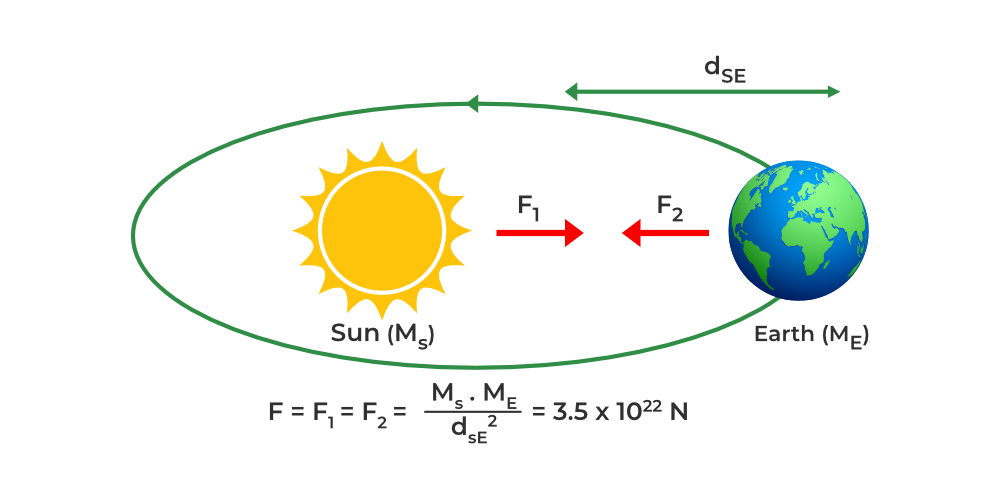
Gravitation, also known as gravitational attraction, is a force that exists between any two objects with mass or energy. It's what keeps us on the ground, what makes the Moon orbit Earth, and what holds galaxies together.
Here's a breakdown of gravitation:
- Universal: Every object in the universe with mass attracts every other object with mass.
- Strength: The strength of the gravitational force depends on the masses of the objects and the distance between them. Greater masses and shorter distances result in a stronger gravitational pull.
- Weaker force: Compared to other fundamental forces like electromagnetism, gravity is a relatively weak force. However, it's the dominant force at large scales, shaping the universe as we know it.
Understanding Gravitation:
There are two main ways to understand gravitation:
- Newton's law of universal gravitation: This law, formulated by Isaac Newton, describes the gravitational attraction between two objects. It states that the force is directly proportional to the product of their masses and inversely proportional to the square of the distance between their centers.
- General relativity: Developed by Albert Einstein, general relativity explains gravitation not as a force, but as a curvature of spacetime caused by the presence of mass and energy.
Impact of Gravitation:
Gravitation plays a crucial role in various phenomena across the universe:
- Formation of celestial bodies: Gravity pulls together dust and gas particles in space, leading to the formation of stars, planets, and moons.
- Planetary motion: The gravitational attraction between the Sun and planets determines their orbits and keeps them revolving around the Sun.
- Tides: The Moon's gravity, along with the Sun's, causes the rise and fall of ocean tides on Earth.
- Structure of galaxies and the universe: Gravity is responsible for the large-scale structure of galaxies and the expansion of the universe.
While the concept of gravity might seem simple on the surface, it's a complex and fascinating force that continues to be explored by physicists.
Kepler's Laws of Planetary Motion:
Kepler's Laws of Planetary Motion are three laws that describe the motion of planets around the Sun. Developed by German astronomer Johannes Kepler in the early 17th century, they laid the foundation for modern celestial mechanics. Here's a breakdown of each law:
Kepler's First Law: The Law of Ellipses
- This law states that planets do not move in perfect circles around the Sun, but rather in elliptical orbits with the Sun located at one focus of the ellipse.
- An ellipse is an oval-shaped curve with two focal points. Circles are a special case of ellipses where the two foci coincide.
Kepler's Second Law: The Law of Areas
- This law states that a line connecting the Sun and a planet sweeps out equal areas of space in equal intervals of time.
- In simpler terms, as a planet travels around its elliptical orbit, it speeds up when it's closer to the Sun (perihelion) and slows down when it's farther (aphelion). This ensures the same amount of area is "covered" by the line connecting the Sun and the planet over a specific time period.
Kepler's Third Law: The Law of Harmonies
- This law states that the square of a planet's orbital period (the time it takes to complete one revolution around the Sun) is directly proportional to the cube of the semi-major axis of its orbit (the average distance between the planet and the Sun).
- Basically, planets farther from the Sun take significantly longer to orbit the Sun compared to planets closer to the Sun.
These laws were a major breakthrough in our understanding of the solar system. They replaced the older Ptolemaic model with a Sun-centered system and provided a more accurate description of planetary motion.
Kepler and the Laws of Planetary Motion
Universal Law of Gravitation:
The universal law of gravitation, formulated by Isaac Newton, describes the attractive force between any two objects with mass in the universe. Here's a closer look:
The Law in a Nutshell:
Every object with mass attracts every other object with mass with a force that is:
- Directly proportional: The greater the masses of the objects, the stronger the gravitational attraction.
- Inversely proportional: The force weakens as the distance between the objects' centers increases. Specifically, the force weakens by the square of the distance.
The Equation:
This relationship can be expressed mathematically by the following equation:
F = G * (m1 * m2) / r^2
Where:
- F is the force of gravity (measured in Newtons)
- G is the gravitational constant (a fixed value, approximately 6.674 × 10^-11 m^3 kg^-1 s^-2)
- m1 and m2 are the masses of the two objects (measured in kilograms)
- r is the distance between the centers of the objects (measured in meters)
Understanding the Proportionality:
- Direct Proportionality to Mass: Imagine two balls of clay. If you double the mass of one ball, the gravitational attraction between them will also double. This makes sense because there's more matter in each object, resulting in a stronger pull.
- Inverse Proportionality to Distance: Imagine holding a ball at arm's length. Now bring it closer to your chest. The gravitational pull feels stronger, right? That's because the distance between you and the ball has decreased. The square of the distance term in the equation signifies this weakening effect as distance increases.
Impact of the Law:
This law has been incredibly important in our understanding of the universe. It helps explain:
- Planetary motion: The gravitational attraction between the Sun and planets keeps them in their orbits.
- Formation of celestial bodies: Gravity pulls together dust and gas particles to form stars, planets, and moons.
- Tides: The Moon's and Sun's gravity cause the rise and fall of ocean tides on Earth.
- Structure of galaxies: Gravity plays a crucial role in shaping the large-scale structure of galaxies.
Limitations:
While incredibly useful, Newton's law of universal gravitation has limitations. It doesn't fully explain the behavior of gravity in very strong gravitational fields or at extremely large scales. For these situations, Einstein's theory of general relativity provides a more accurate description.
In summary, the universal law of gravitation is a fundamental law that describes the attractive force between objects with mass. It has been instrumental in our understanding of the motion of planets, the formation of celestial bodies, and the structure of the universe.
Acceleration due to Gravity and its Variation with Altitude and Depth:
Acceleration Due to Gravity (g) and its Variation
Acceleration due to gravity (represented by the symbol g) is the force that attracts any object with mass towards the center of the Earth. It's what makes things fall and keeps us grounded. However, this force isn't entirely constant and can vary slightly depending on your location.
Variation with Altitude:
- g decreases with increasing altitude: As you move further away from Earth's center, the gravitational pull weakens. Imagine yourself on top of a mountain; you're slightly farther from the Earth's center compared to someone at sea level. Because of this, g will be a tiny bit less at the mountaintop.
Formula:
There's a formula to estimate this variation:
g' = g (1 - 2h/R)
- g' is the acceleration due to gravity at altitude h
- g is the acceleration due to gravity at Earth's surface (around 9.8 m/s²)
- h is the altitude from Earth's surface
- R is the Earth's radius (approximately 6,371 km)
Variation with Depth:
- g decreases slightly with increasing depth: Similar to altitude, as you move deeper into the Earth, the amount of mass attracting you decreases slightly. However, the effect is even smaller compared to altitude because most of Earth's mass is concentrated towards the center.
Important Note:
The decrease in g with both altitude and depth is minimal for most practical purposes. It's only significant for extremely high altitudes (think spacecraft orbits) or very deep underground locations.
Here's a table summarizing the variation:
| Location | Variation of g |
|---|---|
| Higher Altitude | Decreases |
| Deeper Depth | Slightly Decreases |
Additional Points:
- The value of g also varies slightly depending on your location on Earth's surface due to factors like Earth's non-perfect spherical shape and uneven mass distribution.
- These variations in g become important in high-precision calculations like satellite orbital mechanics or geophysical measurements.
I hope this explanation clarifies the concept of acceleration due to gravity and its variation!
GOD AND OUR SUPERDETERMINISTIC UNIVERSE: THE #1 ARGUMENT FOR THE EXISTENCE OF GOD