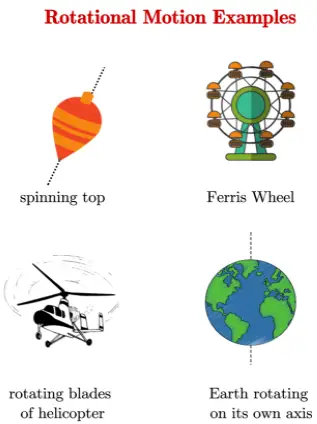
Rotational Motion:
Rotational motion is the motion of an object around a fixed axis. It's a prevalent type of motion in our everyday lives, from the turning of a bicycle wheel to the movement of the Earth on its axis.
Here are some key aspects of rotational motion:
Axis of Rotation: The axis of rotation is the imaginary line around which the object rotates. This line can pass through the object itself or be external to it.
Angular Displacement: This refers to the amount of rotation an object undergoes about the axis, measured in radians (rad).
Angular Velocity: This signifies the rate of change of angular displacement, specifying how fast the object is rotating. It's measured in radians per second (rad/s).
Angular Acceleration: This signifies the rate of change of angular velocity. It indicates how quickly the object's rotational speed is changing and is measured in radians per second squared (rad/s²).
Rotational motion is analyzed in two main areas: kinematics and dynamics. Kinematics deals with the description of rotational motion, while dynamics explores the relationship between the forces acting on a rotating object and the resulting motion.
Rotational motion has numerous applications in various fields, including:
Machines: Rotational motion is fundamental to the operation of many machines, such as gears, turbines, and engines.
Transportation: Vehicles like cars, airplanes, and bicycles rely on rotational motion for their wheels and propellers.
Entertainment: Record players, turntables, and amusement park rides all involve rotational motion.
Energy Production: Wind turbines and power plants utilize rotational motion to generate electricity.
Moment of inertia, often abbreviated as I, is a crucial concept in rotational motion. It's analogous to mass in linear motion and essentially describes an object's resistance to changes in its rotational speed. Here's a breakdown of moment of inertia:
Analogy with Mass:
- In linear motion, mass determines how much force is needed to accelerate an object.
- Similarly, moment of inertia determines the amount of torque required to change an object's rotational speed (angular acceleration).
How it Works:
- Moment of inertia depends on two factors:
- Mass (m) of the object's individual parts: Higher mass means more resistance to rotation.
- Distance (r) of each part from the axis of rotation: Parts farther from the axis contribute more to the moment of inertia because they have a greater rotational effect.
Formula:
- The moment of inertia is calculated by summing the product of each part's mass (m) and the square of its distance (r) from the axis of rotation.
- For a single point mass, the formula is I = mr^2.
- For complex objects, the formula involves integrals and depends on the object's specific shape and mass distribution.
Moment of Inertia in Everyday Life:
- A figure skater spins faster by pulling in their arms. This reduces their moment of inertia, allowing them to spin quicker to conserve angular momentum.
- A merry-go-round with a larger moment of inertia (more massive or spread-out riders) requires more force to get it spinning.
Understanding moment of inertia is essential for analyzing various aspects of rotational motion, including:
- The relationship between torque and angular acceleration
- The rotational kinetic energy of an object
- The design of rotating machinery and objects
If you'd like to delve deeper, I can explain how moment of inertia is calculated for specific shapes or explore its applications in more detail.
Radius of Gyration:
The radius of gyration (often denoted by k) is a concept closely linked to moment of inertia (I) in rotational motion. It provides a simplified way to visualize how an object's mass is distributed relative to the axis of rotation.
Here's how it works:
- Imagine concentrating the entire mass (m) of the object at a single point, a certain distance (k) away from the axis of rotation.
- This hypothetical point would have the same moment of inertia (I) as the actual distribution of mass in the object.
Formula:
The radius of gyration is mathematically related to the moment of inertia and mass through the following formula:
- k = √(I / m)
where: * k is the radius of gyration * I is the moment of inertia * m is the mass of the object
Benefits of Radius of Gyration:
- The radius of gyration offers a single, convenient value to represent how far away the mass of the object is spread out from the axis of rotation, on average.
- This simplifies calculations involving moment of inertia, especially for objects with complex shapes.
Relationship with Moment of inertia:
- A larger radius of gyration (k) indicates that the mass is farther away from the axis of rotation, leading to a higher moment of inertia (I) for the same mass (m).
- Conversely, a smaller radius of gyration signifies the mass is closer to the axis, resulting in a lower moment of inertia.
Applications:
The radius of gyration is useful in various areas of rotational motion, including:
- Estimating moment of inertia: Knowing the radius of gyration and the mass of an object allows you to calculate its moment of inertia using the formula above. This is particularly helpful for objects with standard shapes where the moment of inertia can be expressed in terms of the radius of gyration.
- Analyzing rotating machinery: The radius of gyration helps understand how the mass distribution in a rotating machine affects its rotational behavior.
I can provide you with examples of how to calculate the radius of gyration for specific shapes or delve deeper into its applications in engineering or physics if you'd like.
Values of Moments of Inertia for Simple Geometrical Objects (No Derivation):
Absolutely, here are the moments of inertia (I) for some common geometrical objects around specific axes of rotation (without derivations):
| Shape | Axis | Moment of Inertia (I) |
|---|---|---|
| Thin Hoop (Ring) | Center, perpendicular to plane of the hoop | (M = mass, R = radius) |
| Solid Cylinder | Central axis | (M = mass, R = radius) |
| Solid Sphere | Central axis | (M = mass, R = radius) |
| Hollow Sphere | Central axis | (M = mass, R = radius) |
| Rectangular Plate | Axis parallel to an edge and passing through the center | (M = mass, L = length) |
| Rectangular Plate | Axis parallel to width and passing through the center | (M = mass, W = width) |
Note:
- These formulas apply to objects with uniform mass distribution.
- M represents the total mass of the object.
- The axis of rotation is specified in the table.