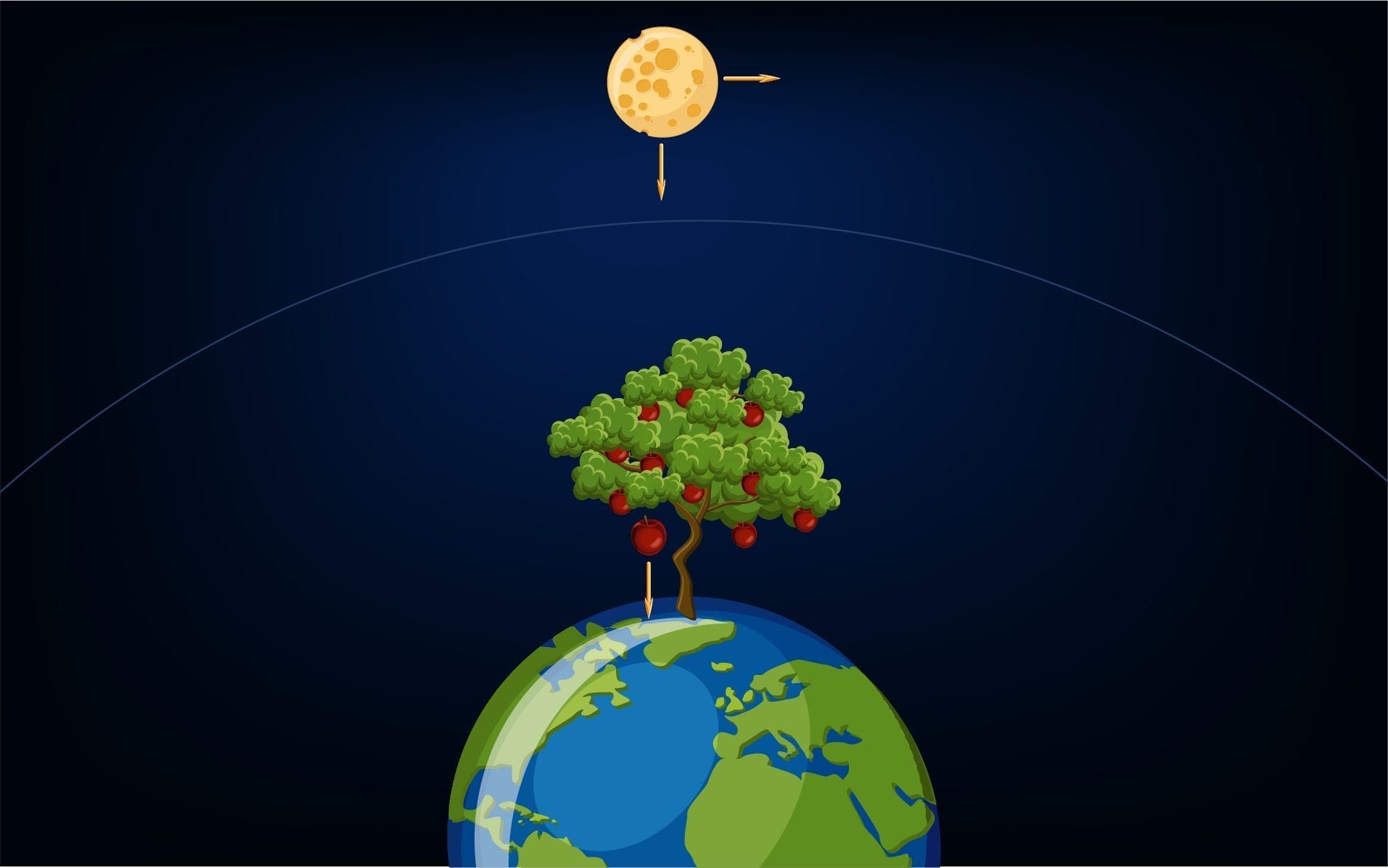
Gravitation:
Gravitation, also known as gravitational attraction, is a force that exists between any two objects with mass or energy. It's the force that keeps you on the ground, that keeps the Moon in orbit around Earth, and that shapes the universe on the largest scales.
Every single particle of matter in the universe exerts a gravitational force on every other particle. The strength of this force depends on the mass of the objects and the distance between them. The greater the mass of an object, the stronger its gravitational pull. The closer two objects are, the stronger the gravitational force between them.
Here are some of the key things to know about gravitation:
- It is a universal force, meaning it acts between all objects with mass or energy.
- It is a weak force compared to the other fundamental forces of nature (electromagnetic, strong nuclear, and weak nuclear). However, it is the dominant force at large scales, because it is always attractive and has an infinite range.
- It is inversely proportional to the square of the distance between two objects. This means that if the distance between two objects doubles, the gravitational force between them will decrease by a factor of four.
Scientists are still working to fully understand gravitation. One of the biggest mysteries is how it relates to quantum mechanics, the theory that describes the behavior of matter and energy at the atomic and subatomic level.
The Gravitational History- from BigBang to Theory of Everything
Gravitational Potential Energy:
Gravitational potential energy (often shortened to GPE) is the energy an object possesses due to its position in a gravitational field. Imagine you hold a book above your head. The book has gravitational potential energy because of its height. If you let go, the gravitational force (gravity) will pull the book down, converting its GPE into kinetic energy (the energy of motion).
Here are some key points about gravitational potential energy:
It depends on two things: the object's mass (m) and its position (height) relative to a chosen reference point. The reference point can be anywhere, but it's common to choose a point far away from any gravitational influence (like infinitely far away from Earth).
Higher potential energy means more work can be done. Lifting a book higher increases its GPE because it takes more work to lift it further against gravity.
The formula for GPE: U_g = mgh
- U_g is the gravitational potential energy (in Joules)
- m is the object's mass (in kilograms)
- g is the acceleration due to gravity (on Earth, about 9.81 m/s²)
- h is the object's height above the reference point (in meters)
GPE can be converted to kinetic energy and vice versa. When you drop the book, its GPE decreases as it falls, and its kinetic energy increases.
Gravitational potential is a concept closely related to gravitational potential energy, but it focuses on the strength of the gravitational field at a specific point, rather than the energy an object has due to its position in that field.
Here's how they differ:
- Gravitational potential energy (GPE): This is the stored energy an object has because of its position in a gravitational field. Higher potential means more stored energy.
- Gravitational potential: This describes the intensity or strength of the gravitational field itself, independent of any object's mass. It tells you how much potential energy an object would have at that point based on its mass (think of it as the "gravitational landscape").
Here are some key points about gravitational potential:
- Formula: Φ = -GM / r (Phi = gravitational potential, G = gravitational constant, M = mass of the attracting object, r = distance from the center of the attracting object)
- Note that the potential is negative, which is a convention.
- Units: Joules per kilogram (J/kg)
- Interpretation: A more negative potential signifies a stronger gravitational field. Imagine a ball rolling on a hill with varying slopes. Steeper slopes (more negative potential) represent stronger gravitational pull.
- Relationship to GPE: We can calculate the GPE of an object using its mass (m) and the gravitational potential (Φ) at its location: GPE = mΦ
Here are some additional points to consider:
- Gravitational potential is a scalar quantity, meaning it has only magnitude (strength) and not direction (unlike force).
- Just like GPE, it's often convenient to choose a reference point where the potential is set to zero (often set to infinity for simplicity).
Understanding both gravitational potential energy and potential allows for a deeper understanding of how objects behave in gravitational fields.
Passion for Compasses: Medieval Master Builders and their Cathedral Building Plans
Escape Speed:
Escape speed, also sometimes called escape velocity, is the minimum speed an object needs to achieve in order to escape the gravitational pull of a celestial body (like Earth) and travel freely into outer space. It's like jumping high enough to never come back down.
Here's how it works:
- An object near a massive body, like Earth, has gravitational potential energy (GPE) due to its position in the gravitational field.
- To escape this gravitational pull completely, the object's kinetic energy (energy of motion) needs to be greater than its GPE at that location.
- Escape speed is the velocity required for an object to reach this threshold where its kinetic energy exactly cancels out its GPE, allowing it to move infinitely far away without further acceleration.
Formula:
Escape speed (v_esc) can be calculated using the following formula:
v_esc = √(2GM / r)
- G is the gravitational constant (a fixed value)
- M is the mass of the celestial body (like Earth's mass)
- r is the distance between the object's center and the center of the celestial body
Escape speed of Earth:
For Earth, the escape speed at its surface is approximately 11.2 kilometers per second (about 40,270 km/h or 25,020 mph). This is a very high speed, highlighting the strong gravitational pull of our planet.
Important factors:
- Escape speed depends on the mass of the celestial body and the distance from its center. A more massive object or a closer starting point will require a higher escape speed.
- Escape speed only considers the object's initial velocity and doesn't include air resistance or any other forces acting on it after launch.
Additional points:
- Objects achieving escape velocity can still be captured by the gravity of other celestial bodies they encounter in space.
- Escape speed is crucial for spacecraft launches, as they need to reach this speed to break free from Earth's gravity and travel to other destinations in the solar system or beyond.
Orbital velocity, also known as satellite velocity, is the speed required for a satellite to maintain a stable orbit around a celestial body like Earth. It's the sweet spot where the satellite's inertia (tendency to move in a straight line) is balanced by the gravitational pull of the Earth, causing it to continuously fall towards Earth but miss the ground by always moving sideways at the right speed.
Here's the key concept:
- Orbital velocity depends on the distance between the satellite and the center of the Earth (not just the altitude from the surface). Farther orbits require a slower velocity.
Factors affecting orbital velocity:
- Gravitational pull of Earth: Stronger pull for closer orbits necessitates a faster velocity to maintain balance.
- Orbital radius: Larger distance from Earth (higher orbit) allows for a slower orbital velocity.
Formula:
We can calculate the orbital velocity (v) using the following formula:
v = √(GM / r)
- G is the gravitational constant (a fixed value)
- M is the mass of Earth
- r is the distance between the satellite's center and the center of Earth (orbital radius)
Examples:
- Low Earth Orbit (LEO): Satellites in LEO, typically between 160 km and 2000 km above Earth, travel at speeds around 7.0 to 7.8 km/s (25,200 to 28,100 km/h).
- Geostationary Orbit (GEO): Satellites in GEO, at an altitude of about 35,786 km, match Earth's rotation and appear stationary from the ground. Their orbital velocity is about 3.07 km/s (11,140 km/h).
Relation to escape velocity:
Escape velocity is significantly higher than orbital velocity at a specific altitude. While escape velocity allows an object to completely break free from Earth's gravity, orbital velocity allows the object to remain tethered in a stable path.
Strange New Worlds: The Search for Alien Planets and Life beyond Our Solar System