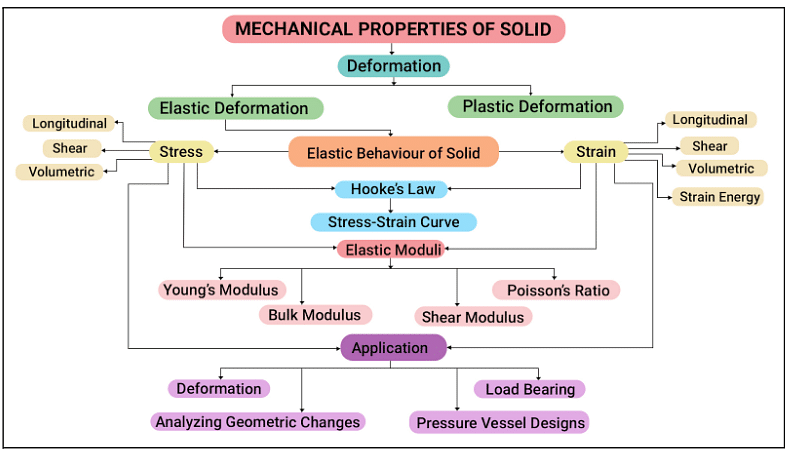
Mechanical Properties of Solids:
The mechanical properties of solids are crucial for understanding how materials respond to various forces and conditions. These properties are essential in the design and analysis of materials for engineering applications. Here are some key mechanical properties of solids:
### 1. **Elasticity**
- **Definition**: The ability of a material to return to its original shape after the removal of a deforming force.
- **Key Parameters**:
- **Young's Modulus (E)**: Measures the stiffness of a material. It is the ratio of stress (force per unit area) to strain (deformation in response to stress).
- **Shear Modulus (G)**: Measures the material's response to shear stress.
- **Bulk Modulus (K)**: Measures the material's response to uniform pressure.
### 2. **Plasticity**
- **Definition**: The ability of a material to undergo permanent deformation without breaking when a force is applied.
- **Yield Strength**: The stress at which a material begins to deform plastically.
### 3. **Ductility**
- **Definition**: The ability of a material to undergo significant plastic deformation before rupture.
- **Measurement**: Often measured by the percentage elongation or reduction in area in a tensile test.
### 4. **Brittleness**
- **Definition**: The tendency of a material to fracture without significant plastic deformation.
- **Characteristic**: Brittle materials absorb relatively little energy prior to fracture.
### 5. **Toughness**
- **Definition**: The ability of a material to absorb energy and plastically deform without fracturing.
- **Measurement**: Often measured using impact tests, such as the Charpy or Izod tests.
### 6. **Hardness**
- **Definition**: The resistance of a material to deformation, particularly permanent deformation, scratching, cutting, or abrasion.
- **Measurement**: Common hardness tests include the Mohs, Rockwell, Brinell, and Vickers tests.
### 7. **Strength**
- **Ultimate Tensile Strength (UTS)**: The maximum stress that a material can withstand while being stretched or pulled before breaking.
- **Compressive Strength**: The maximum compressive stress that a material can withstand without failure.
- **Shear Strength**: The maximum shear stress that a material can endure before failure.
### 8. **Fatigue**
- **Definition**: The weakening of a material caused by repeatedly applied loads.
- **Fatigue Strength**: The highest stress that a material can withstand for a given number of cycles without breaking.
- **Endurance Limit**: The maximum stress below which a material can endure an essentially infinite number of stress cycles without failing.
### 9. **Creep**
- **Definition**: The slow, time-dependent deformation of a material under a constant load.
- **Primary, Secondary, and Tertiary Creep**: The stages of creep behavior, where the material initially deforms quickly (primary), then at a steady rate (secondary), and finally accelerates to failure (tertiary).
### 10. **Fracture Toughness**
- **Definition**: The ability of a material with a crack to resist fracture.
- **Measurement**: Often determined using tests that introduce a crack and measure the stress intensity factor at which the crack propagates.
### 11. **Poisson's Ratio**
- **Definition**: The ratio of the transverse strain to the axial strain in a material subjected to axial stress.
- **Typical Values**: For most materials, Poisson's ratio ranges from 0.25 to 0.35.
Understanding these properties helps engineers and materials scientists select the right materials for specific applications, ensuring safety, durability, and efficiency in the products they design and manufacture.
Elasticity:
Elasticity is a fundamental mechanical property of materials that describes their ability to return to their original shape after being deformed by an external force. This property is crucial in many engineering applications where materials must withstand forces without permanent deformation. Here are the key concepts and parameters associated with elasticity:
### Key Concepts in Elasticity
1. **Stress and Strain**:
- **Stress (\(\sigma\))**: The force applied per unit area within materials. It is measured in pascals (Pa) or megapascals (MPa).
- **Formula**: \(\sigma = \frac{F}{A}\)
- \(F\) is the applied force, and \(A\) is the cross-sectional area.
- **Strain (\(\epsilon\))**: The deformation or displacement per unit length resulting from applied stress. It is a dimensionless quantity.
- **Formula**: \(\epsilon = \frac{\Delta L}{L_0}\)
- \(\Delta L\) is the change in length, and \(L_0\) is the original length.
2. **Hooke’s Law**:
- States that, within the elastic limit of a material, the strain is directly proportional to the applied stress.
- **Formula**: \(\sigma = E \cdot \epsilon\)
- \(E\) is Young's Modulus, a constant for a given material.
### Elastic Moduli
1. **Young's Modulus (E)**:
- Measures the stiffness of a material in tension or compression.
- **Formula**: \(E = \frac{\sigma}{\epsilon}\)
- High Young's modulus indicates a stiff material.
2. **Shear Modulus (G)**:
- Measures the material's response to shear stress.
- **Formula**: \(G = \frac{\tau}{\gamma}\)
- \(\tau\) is the shear stress, and \(\gamma\) is the shear strain.
- Important for understanding how materials deform under forces that cause layers to slide.
3. **Bulk Modulus (K)**:
- Measures a material's response to uniform pressure.
- **Formula**: \(K = -V \cdot \frac{dP}{dV}\)
- \(V\) is the original volume, \(P\) is the pressure, and \(dV\) is the change in volume.
- High bulk modulus indicates resistance to compression.
### Poisson's Ratio (\(\nu\))
- Describes the ratio of transverse strain to axial strain in a material subjected to axial stress.
- **Formula**: \(\nu = -\frac{\epsilon_{\text{transverse}}}{\epsilon_{\text{axial}}}\)
- Typical values range from 0.25 to 0.35 for most materials. A material with a high Poisson's ratio exhibits significant lateral expansion when compressed.
### Elastic Limit and Proportional Limit
- **Elastic Limit**: The maximum stress that a material can withstand without permanent deformation.
- **Proportional Limit**: The maximum stress up to which the stress-strain relationship is linear and Hooke's Law is applicable.
### Types of Elasticity
1. **Linear Elasticity**:
- Assumes that the material deforms linearly with applied stress and returns to its original shape upon unloading.
- Governed by Hooke's Law.
2. **Nonlinear Elasticity**:
- Describes materials that do not have a linear stress-strain relationship, yet still return to their original shape after unloading.
### Applications of Elasticity
- **Structural Engineering**: Designing beams, bridges, buildings to ensure they can withstand loads without permanent deformation.
- **Mechanical Components**: Springs, shafts, and machine parts that must return to their original shape after load removal.
- **Material Science**: Developing new materials with desired elastic properties for various industrial applications.
### Summary
Elasticity is a critical property for materials used in various engineering applications, ensuring that they can endure loads and return to their original form without permanent deformation. Understanding and measuring elasticity allows engineers to design safer and more efficient structures and components.
Stress-Strain Relationship:
The stress-strain relationship is a fundamental concept in material science and engineering that describes how a material deforms under applied stress. This relationship is crucial for understanding the mechanical behavior of materials and is typically represented by a stress-strain curve obtained from tensile tests.
### Key Concepts
1. **Stress (\(\sigma\))**:
- Defined as the force (\(F\)) applied per unit area (\(A\)).
- **Formula**: \(\sigma = \frac{F}{A}\)
- Measured in pascals (Pa) or megapascals (MPa).
2. **Strain (\(\epsilon\))**:
- Defined as the deformation (\(\Delta L\)) per unit length (\(L_0\)).
- **Formula**: \(\epsilon = \frac{\Delta L}{L_0}\)
- Dimensionless quantity.
### Stress-Strain Curve
The stress-strain curve provides a graphical representation of the relationship between stress and strain for a material. The curve can be divided into several regions, each representing different mechanical behaviors:
1. **Proportional Limit**:
- The initial linear region of the curve where stress is directly proportional to strain.
- Follows Hooke's Law: \(\sigma = E \cdot \epsilon\)
- \(E\) is Young's modulus.
2. **Elastic Region**:
- Extends up to the elastic limit, beyond which the material will no longer return to its original shape upon unloading.
- Material deforms elastically (reversibly).
3. **Yield Point**:
- The point at which the material begins to deform plastically.
- Characterized by the yield stress (\(\sigma_y\)), the stress at which permanent deformation begins.
4. **Plastic Region**:
- Beyond the yield point, the material deforms plastically (irreversibly).
- Strain increases at a greater rate with applied stress.
5. **Ultimate Tensile Strength (UTS)**:
- The maximum stress the material can withstand.
- Represents the peak of the stress-strain curve.
6. **Necking and Fracture**:
- After reaching the UTS, the material undergoes necking, where the cross-sectional area reduces significantly.
- Eventually, the material fractures at the breaking point.
### Types of Stress-Strain Curves
Different materials exhibit different types of stress-strain curves:
1. **Ductile Materials**:
- Exhibit significant plastic deformation before fracture.
- Stress-strain curve shows a long plastic region.
2. **Brittle Materials**:
- Fracture with little to no plastic deformation.
- Stress-strain curve shows a short or non-existent plastic region.
### Important Parameters
1. **Young's Modulus (E)**:
- Slope of the linear portion of the stress-strain curve.
- Indicates material stiffness.
2. **Yield Strength (\(\sigma_y\))**:
- Stress at which plastic deformation begins.
- Important for determining safe load limits.
3. **Ultimate Tensile Strength (UTS)**:
- Maximum stress the material can endure.
- Indicates the material's maximum load-bearing capacity.
4. **Ductility**:
- Measure of plastic deformation before fracture.
- Often indicated by the percentage elongation or reduction in area.
5. **Resilience**:
- The area under the elastic region of the stress-strain curve.
- Represents the energy absorbed per unit volume before yielding.
6. **Toughness**:
- The total area under the stress-strain curve.
- Represents the energy absorbed per unit volume until fracture.
### Summary
The stress-strain relationship is essential for understanding the mechanical behavior of materials under load. By analyzing the stress-strain curve, engineers can determine crucial properties like Young's modulus, yield strength, and ductility, which are vital for material selection and structural design.
Modelling the Stress-Strain Relationship in Work Settings (Routledge Progress in Psychology)
Hooke's Law:
Hooke's Law is a fundamental principle in mechanics that describes the linear relationship between the force applied to a material and the resulting deformation within the elastic limit of that material. Named after the 17th-century British physicist Robert Hooke, this law is essential for understanding how materials behave under small deformations.
### Hooke's Law Formula
For a material subjected to axial loading (tension or compression):
\[ \sigma = E \cdot \epsilon \]
- \(\sigma\) is the stress (force per unit area).
- \(E\) is Young's modulus (a measure of the material's stiffness).
- \(\epsilon\) is the strain (relative deformation or change in length).
In terms of force (\(F\)) and displacement (\(\Delta L\)):
\[ F = k \cdot \Delta L \]
- \(F\) is the applied force.
- \(k\) is the spring constant or stiffness of the material.
- \(\Delta L\) is the change in length.
### Young's Modulus
Young's Modulus (\(E\)) is a material constant that quantifies the stiffness of a material. It is defined as the ratio of stress to strain in the linear elastic region of the stress-strain curve.
\[ E = \frac{\sigma}{\epsilon} \]
- Units: Pascals (Pa), often expressed in gigapascals (GPa) for engineering materials.
### Applications of Hooke's Law
1. **Structural Engineering**:
- Designing beams, columns, and other structural elements to ensure they remain within the elastic limit under load.
2. **Mechanical Engineering**:
- Analyzing components like springs, rods, and shafts to predict their behavior under forces and ensure they function correctly.
3. **Material Science**:
- Characterizing materials by determining their elastic properties and ensuring they are suitable for specific applications.
### Limitations of Hooke's Law
1. **Elastic Limit**:
- Hooke's Law is only valid within the elastic limit of the material, where the stress-strain relationship is linear.
2. **Nonlinear Materials**:
- Materials that exhibit significant nonlinearity or plastic deformation do not follow Hooke's Law beyond the proportional limit.
3. **Complex Loading**:
- For materials subjected to complex loading conditions (e.g., shear, torsion), Hooke's Law must be generalized to account for different types of stress and strain.
### Generalized Hooke's Law
For isotropic materials under three-dimensional stress states, the generalized Hooke's Law relates stress and strain using stiffness coefficients:
\[ \sigma_{ij} = \sum_{k=1}^{3} \sum_{l=1}^{3} C_{ijkl} \cdot \epsilon_{kl} \]
- \(\sigma_{ij}\) are the stress components.
- \(\epsilon_{kl}\) are the strain components.
- \(C_{ijkl}\) are the stiffness coefficients (tensor).
In matrix form for isotropic materials:
\[ \begin{pmatrix}
\sigma_x \\
\sigma_y \\
\sigma_z \\
\sigma_{xy} \\
\sigma_{yz} \\
\sigma_{zx}
\end{pmatrix}
=
\begin{pmatrix}
E/(1-\nu^2) & \nu E/(1-\nu^2) & \nu E/(1-\nu^2) & 0 & 0 & 0 \\
\nu E/(1-\nu^2) & E/(1-\nu^2) & \nu E/(1-\nu^2) & 0 & 0 & 0 \\
\nu E/(1-\nu^2) & \nu E/(1-\nu^2) & E/(1-\nu^2) & 0 & 0 & 0 \\
0 & 0 & 0 & G & 0 & 0 \\
0 & 0 & 0 & 0 & G & 0 \\
0 & 0 & 0 & 0 & 0 & G
\end{pmatrix}
\begin{pmatrix}
\epsilon_x \\
\epsilon_y \\
\epsilon_z \\
\epsilon_{xy} \\
\epsilon_{yz} \\
\epsilon_{zx}
\end{pmatrix} \]
- \(E\) is Young's modulus.
- \(\nu\) is Poisson's ratio.
- \(G\) is the shear modulus.
### Summary
Hooke's Law is a cornerstone of elasticity theory, providing a simple yet powerful model for understanding the behavior of materials under small deformations. Its applications span numerous fields in science and engineering, enabling the design and analysis of structures and components that remain within their elastic limits.
Young’s Modulus:
Young's modulus, also known as the modulus of elasticity, is a fundamental material property that measures the stiffness of a solid material. It quantifies the relationship between stress (force per unit area) and strain (proportional deformation) in a material under elastic deformation. Named after the British scientist Thomas Young, it is a crucial parameter in engineering and materials science for predicting how materials will behave under various types of loads.
### Definition and Formula
Young's modulus (E) is defined as the ratio of tensile stress (\(\sigma\)) to tensile strain (\(\epsilon\)) in the linear elastic region of the material's stress-strain curve.
\[ E = \frac{\sigma}{\epsilon} \]
- **Stress (\(\sigma\))**: The force applied per unit area. It is measured in pascals (Pa).
\[ \sigma = \frac{F}{A} \]
where \(F\) is the applied force and \(A\) is the cross-sectional area over which the force is applied.
- **Strain (\(\epsilon\))**: The relative deformation or change in length.
\[ \epsilon = \frac{\Delta L}{L_0} \]
where \(\Delta L\) is the change in length and \(L_0\) is the original length.
### Units
- The SI unit of Young's modulus is the pascal (Pa), but it is often expressed in gigapascals (GPa) for engineering materials because typical values are quite large.
- \(1 \text{ GPa} = 10^9 \text{ Pa}\)
### Physical Significance
- **Stiffness**: Young's modulus is a measure of a material's stiffness. A higher Young's modulus indicates a stiffer material that deforms less under the same applied stress.
- **Elasticity**: It describes the elastic properties of a material when it is stretched or compressed. Materials with a high Young's modulus return to their original shape more quickly when the load is removed.
### Typical Values
Different materials have different Young's moduli, reflecting their stiffness. Here are some typical values:
- **Metals**:
- Steel: ~210 GPa
- Aluminum: ~70 GPa
- Copper: ~110 GPa
- **Polymers**:
- Polyethylene: ~0.8 GPa
- Polystyrene: ~3 GPa
- **Ceramics**:
- Alumina: ~400 GPa
- Silicon carbide: ~450 GPa
- **Biological Materials**:
- Bone: ~14-30 GPa
- Tendon: ~1.5 GPa
### Applications
1. **Structural Engineering**: Used to design buildings, bridges, and other structures, ensuring they can withstand applied loads without excessive deformation.
2. **Mechanical Engineering**: Important for the design of machine parts, such as shafts, beams, and springs, ensuring they maintain their shape under operational stresses.
3. **Material Science**: Helps in the selection of materials for specific applications based on their stiffness and elastic properties.
4. **Aerospace and Automotive**: Used to design lightweight yet strong components that can withstand high stress and strain during operation.
### Calculation Example
Consider a steel rod with the following parameters:
- Original length (\(L_0\)): 1 meter
- Cross-sectional area (\(A\)): 0.01 square meters
- Applied force (\(F\)): 1000 newtons
- Elongation (\(\Delta L\)): 0.0005 meters
First, calculate the stress (\(\sigma\)):
\[ \sigma = \frac{F}{A} = \frac{1000 \text{ N}}{0.01 \text{ m}^2} = 100,000 \text{ Pa} \]
Next, calculate the strain (\(\epsilon\)):
\[ \epsilon = \frac{\Delta L}{L_0} = \frac{0.0005 \text{ m}}{1 \text{ m}} = 0.0005 \]
Now, calculate Young's modulus (E):
\[ E = \frac{\sigma}{\epsilon} = \frac{100,000 \text{ Pa}}{0.0005} = 200,000,000 \text{ Pa} = 200 \text{ MPa} \]
### Summary
Young's modulus is a crucial mechanical property that quantifies the stiffness of a material under elastic deformation. It is widely used in engineering and material science to design and analyze structures and components that must withstand mechanical loads without undergoing permanent deformation. By understanding Young's modulus, engineers can select appropriate materials and predict how they will behave under different loading conditions.
NERF Modulus Stryfe Blaster (Amazon Exclusive)
Bulk Modulus:
The bulk modulus (K) is a measure of a material's resistance to uniform compression. It is a fundamental property that describes how incompressible or compressible a material is when subjected to uniform pressure from all sides. Bulk modulus is particularly important in fields such as material science, geophysics, and engineering.
### Definition and Formula
The bulk modulus (K) is defined as the ratio of the infinitesimal pressure increase to the resulting relative decrease of the volume.
\[ K = -V \frac{dP}{dV} \]
- \( K \) is the bulk modulus.
- \( V \) is the original volume.
- \( dP \) is the infinitesimal increase in pressure.
- \( dV \) is the infinitesimal decrease in volume.
For finite changes in volume and pressure, the bulk modulus can be approximated as:
\[ K = - \frac{\Delta P}{\frac{\Delta V}{V}} = \frac{\Delta P \cdot V}{\Delta V} \]
- \( \Delta P \) is the change in pressure.
- \( \Delta V \) is the change in volume.
- \( V \) is the original volume.
### Units
- The SI unit of bulk modulus is the pascal (Pa), similar to other modulus measures such as Young's modulus and shear modulus.
- Bulk modulus is often expressed in gigapascals (GPa) when dealing with materials like metals, ceramics, and rocks due to the large values involved.
- \(1 \text{ GPa} = 10^9 \text{ Pa}\)
### Physical Significance
- **Incompressibility**: A high bulk modulus indicates that a material is very incompressible, meaning it does not change its volume much under pressure.
- **Compressibility**: The reciprocal of the bulk modulus is called compressibility. It measures how much a material's volume decreases under pressure.
### Typical Values
Different materials have different bulk moduli, reflecting their compressibility:
- **Gases**: Very low bulk modulus (high compressibility).
- Air: ~0.0001 GPa
- **Liquids**: Higher bulk modulus than gases but lower than solids.
- Water: ~2.2 GPa
- **Solids**: Generally have high bulk moduli.
- Steel: ~160 GPa
- Aluminum: ~70 GPa
- Glass: ~35 GPa
- Diamond: ~443 GPa
### Applications
1. **Material Science**: Bulk modulus helps in selecting materials for applications where resistance to compression is crucial.
2. **Geophysics**: Used to study the properties of Earth's materials, as well as those of other planets and moons.
3. **Engineering**: Important in designing structures and components that must withstand high pressures, such as submarines, deep-sea equipment, and pressure vessels.
4. **Acoustics**: Bulk modulus is related to the speed of sound in a material. A higher bulk modulus typically means a higher speed of sound.
### Calculation Example
Consider a material with the following parameters:
- Original volume (\(V\)): 1 cubic meter
- Change in pressure (\(\Delta P\)): 100 megapascals (100 MPa)
- Resulting volume decrease (\(\Delta V\)): 0.0005 cubic meters
First, convert the change in pressure to pascals:
\[ \Delta P = 100 \text{ MPa} = 100 \times 10^6 \text{ Pa} \]
Now, calculate the bulk modulus (\(K\)):
\[ K = \frac{\Delta P \cdot V}{\Delta V} = \frac{100 \times 10^6 \text{ Pa} \times 1 \text{ m}^3}{0.0005 \text{ m}^3} = \frac{100 \times 10^6}{0.0005} = 200 \times 10^9 \text{ Pa} = 200 \text{ GPa} \]
### Summary
The bulk modulus is a crucial mechanical property that quantifies a material's resistance to uniform compression. It is essential for understanding the compressibility of materials and has significant applications in material science, engineering, geophysics, and acoustics. By knowing the bulk modulus, engineers and scientists can predict how materials will behave under different pressure conditions and design systems accordingly.