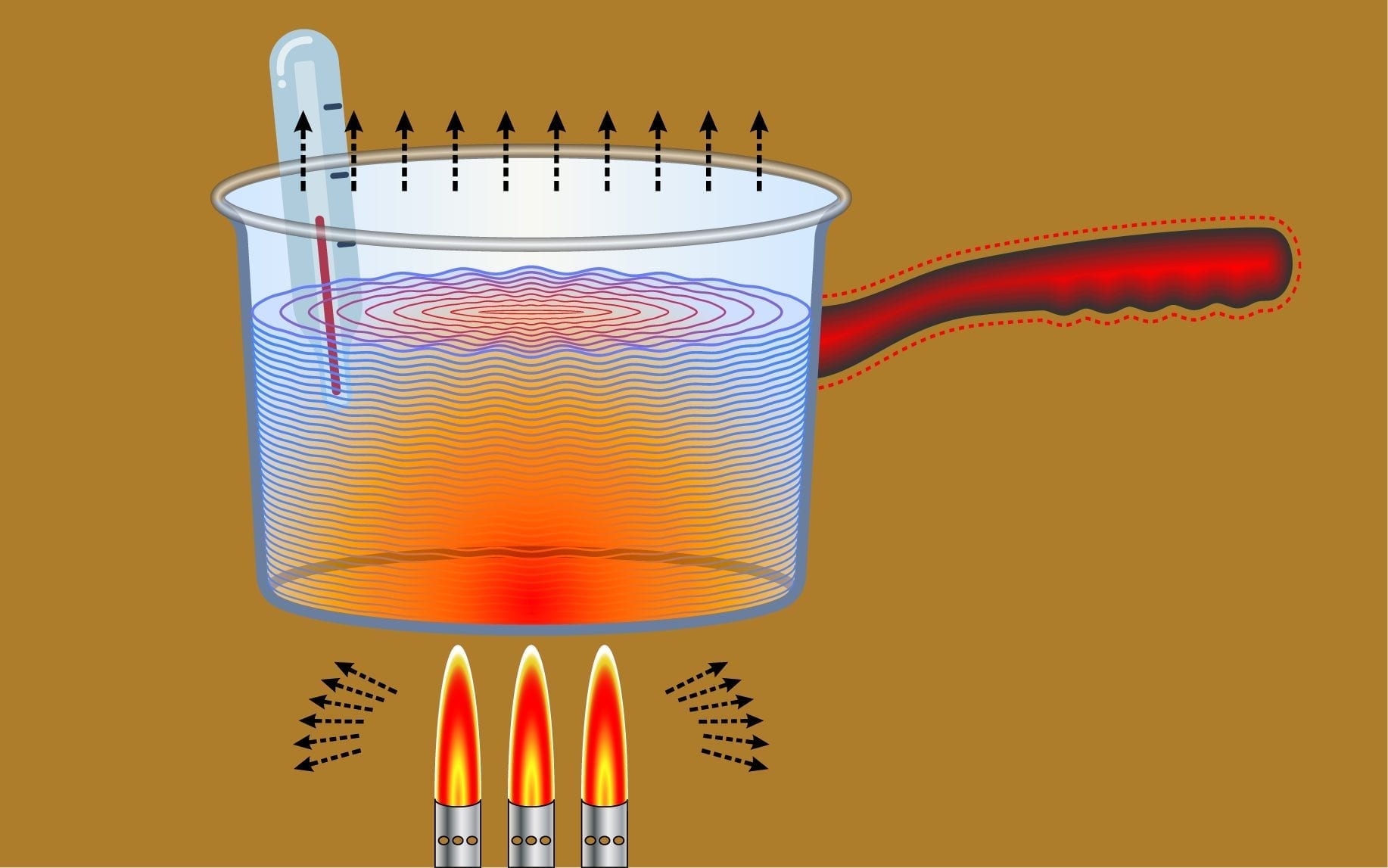
Thermal Properties of Matter:
Thermal Properties of Matter
Thermal properties refer to the characteristics of a substance related to its ability to absorb, store, and transfer heat energy. These properties are crucial in various fields, including engineering, materials science, and thermodynamics.
Key Thermal Properties
- Temperature: A measure of the average kinetic energy of the particles in a substance. It is often measured in degrees Celsius (°C), Fahrenheit (°F), or Kelvin (K).
- Heat: A form of energy that flows from a hotter object to a colder one due to a temperature difference. It is often measured in joules (J).
- Specific Heat Capacity: The amount of heat required to raise the temperature of one unit mass of a substance by one degree Celsius.
It is a measure of a substance's ability to store heat. - Thermal Conductivity: A measure of a substance's ability to conduct heat. A material with high thermal conductivity transfers heat efficiently, while a material with low thermal conductivity is a poor conductor of heat.
- Thermal Expansion: The increase in the volume or length of a substance when its temperature is increased. Different materials have varying rates of thermal expansion.
- Latent Heat: The amount of heat required to change the state of a substance without changing its temperature. Latent heat can be either latent heat of fusion (for melting or freezing) or latent heat of vaporization (for boiling or condensing).
Applications of Thermal Properties
- Materials Selection: Thermal properties are essential in selecting materials for various applications, such as building insulation, cookware, and heat exchangers.
- Thermal Engineering: Engineers use thermal properties to design and analyze systems that involve heat transfer, such as power plants, HVAC systems, and refrigeration equipment.
- Thermodynamics: The study of heat and work is based on the understanding of thermal properties.
- Material Characterization: Thermal properties can be used to identify and characterize materials.
Would you like to know more about a specific thermal property or its applications?
THE COSMIC CODE: A Journey to the Origin of the Universe (Cutting-Edge Sciences)
Heat:
Heat: A Form of Energy
Heat is a form of energy that flows from a hotter object to a colder one due to a temperature difference. It is a measure of the total kinetic energy of the particles in a substance.
Key Points about Heat:
- Direction of Flow: Heat always flows from a hotter object to a colder one.
- Temperature Difference: The rate of heat transfer depends on the temperature difference between the two objects.
- Units of Measurement: Heat is typically measured in joules (J).
- Relation to Temperature: While temperature is a measure of the average kinetic energy of particles, heat is a measure of the total kinetic energy.
Heat Transfer Mechanisms:
There are three primary ways heat can be transferred:
- Conduction: Heat transfer through direct contact between particles. This is how heat is transferred through solid materials.
- Convection: Heat transfer through the movement of a fluid (liquid or gas). This is how heat is transferred in a pot of boiling water or by the wind.
- Radiation: Heat transfer through electromagnetic waves. This is how heat from the sun reaches Earth.
Applications of Heat:
Heat is essential for many processes, including:
- Cooking: Heat is used to cook food.
- Heating: Heat is used to warm homes and buildings.
- Power Generation: Heat is used to generate electricity in power plants.
- Industrial Processes: Heat is used in various industrial processes, such as metalworking and chemical reactions.
Would you like to know more about a specific aspect of heat, such as heat transfer mechanisms or applications?
Temperature:
Temperature: A Measure of Heat
Temperature is a measure of the average kinetic energy of the particles in a substance. It is a way to quantify how hot or cold something is.
Key Points About Temperature:
- Kinetic Energy: Higher temperature means the particles in a substance are moving faster on average.
- Units of Measurement: Temperature is typically measured in degrees Celsius (°C), Fahrenheit (°F), or Kelvin (K).
- Absolute Zero: The lowest possible temperature is absolute zero, which is 0 Kelvin or -273.15 degrees Celsius. At this temperature, all particle motion would cease.
- Temperature Scales:
- Celsius: Based on the freezing point of water (0°C) and the boiling point of water (100°C).
- Fahrenheit: Based on the freezing point of a salt solution (0°F) and the boiling point of water (212°F).
- Kelvin: An absolute temperature scale that starts at absolute zero.
Temperature Measurement:
Temperature is typically measured using a thermometer. Thermometers can be based on various principles, such as:
- Expansion of a liquid: As the temperature increases, the liquid expands and rises in a tube.
- Resistance of a metal: The electrical resistance of a metal changes with temperature.
- Radiation emitted by an object: Infrared thermometers measure the radiation emitted by an object to determine its temperature.
Would you like to know more about a specific temperature scale or temperature measurement method?
Thermal Expansion:
Thermal Expansion
Thermal expansion is the increase in the volume or length of a substance when its temperature is increased. This phenomenon occurs because the atoms or molecules in a substance vibrate more rapidly as the temperature rises, causing them to move further apart.
Key Points About Thermal Expansion:
- Coefficient of Linear Expansion: A measure of how much a material expands per unit length for a given temperature increase.
- Coefficient of Volume Expansion: A measure of how much a material expands per unit volume for a given temperature increase.
- Factors Affecting Thermal Expansion: The type of material, its crystal structure, and the temperature range all affect thermal expansion.
- Applications of Thermal Expansion:
- Thermometers: The expansion of a liquid in a thermometer is used to measure temperature.
- Thermostats: Bimetallic strips that expand at different rates are used in thermostats to control temperature.
- Engineering Design: Thermal expansion must be considered in the design of structures, bridges, and other large objects to prevent damage due to temperature changes.
Examples of Thermal Expansion:
- Hot air balloon: The hot air inside the balloon expands, making it less dense than the surrounding air and causing it to rise.
- Power lines: Power lines are often installed with a slight sag to accommodate thermal expansion in hot weather.
- Railway tracks: Gaps are left between railway tracks to allow for thermal expansion and prevent buckling.
Would you like to know more about a specific aspect of thermal expansion, such as its applications or the factors that affect it?
PH5 FLEX2PRO Thermal Expansion Tank - 2.1 Gallon
Thermal Expansion of Solids:
Thermal Expansion of Solids
Thermal expansion of solids is the increase in the length, area, or volume of a solid material when its temperature is increased. This phenomenon is due to the increased vibrational motion of the atoms or molecules within the solid material.
Factors Affecting Thermal Expansion of Solids:
- Temperature: The higher the temperature increase, the greater the thermal expansion.
- Material: Different materials have different coefficients of thermal expansion. For example, metals generally expand more than ceramics.
- Crystal Structure: The arrangement of atoms in a solid's crystal structure can influence its thermal expansion.
- Impurities: Impurities in a material can affect its thermal expansion properties.
Applications of Thermal Expansion of Solids:
- Thermometers: The expansion of a liquid in a thermometer is based on the thermal expansion of solids.
- Thermostats: Bimetallic strips, made of two metals with different coefficients of thermal expansion, are used in thermostats to control temperature.
- Engineering Design: Thermal expansion must be considered in the design of structures, bridges, and other large objects to prevent damage due to temperature changes. For example, gaps are left between railway tracks to accommodate thermal expansion.
- Material Characterization: The thermal expansion coefficient of a material can be used to identify and characterize it.
Coefficient of Linear Expansion:
The coefficient of linear expansion (α) is a measure of how much a solid material expands per unit length for a given temperature increase. It is defined as:
α = ΔL / (L₀ ΔT)
where:
- ΔL is the change in length
- L₀ is the original length
- ΔT is the change in temperature
Coefficient of Volume Expansion:
The coefficient of volume expansion (β) is a measure of how much a solid material expands per unit volume for a given temperature increase. It is related to the coefficient of linear expansion by:
β ≈ 3α
This approximation is valid for most solids.
Would you like to know more about a specific application of thermal expansion of solids or the factors that affect it?
Solid State Physics: An Introduction
Thermal Expansion of Liquids:
Thermal Expansion of Liquids
Thermal expansion of liquids is the increase in the volume of a liquid when its temperature is increased. This phenomenon occurs because the molecules in the liquid move more rapidly as the temperature rises, causing them to occupy more space.
Factors Affecting Thermal Expansion of Liquids:
- Temperature: The higher the temperature increase, the greater the thermal expansion.
- Liquid: Different liquids have different coefficients of thermal expansion. For example, water has an unusual behavior, expanding from 0°C to 4°C before contracting.
- Pressure: The pressure on a liquid can affect its thermal expansion.
Applications of Thermal Expansion of Liquids:
- Thermometers: Many thermometers use the expansion of a liquid, such as mercury or alcohol, to measure temperature.
- Engine Coolants: The expansion of engine coolant helps to transfer heat away from the engine.
- Fire Sprinkler Systems: The expansion of water in a fire sprinkler system can activate the sprinklers when a fire occurs.
- Material Characterization: The thermal expansion coefficient of a liquid can be used to identify and characterize it.
Coefficient of Volume Expansion:
The coefficient of volume expansion (β) is a measure of how much a liquid expands per unit volume for a given temperature increase. It is defined as:
β = ΔV / (V₀ ΔT)
where:
- ΔV is the change in volume
- V₀ is the original volume
- ΔT is the change in temperature
Would you like to know more about a specific application of thermal expansion of liquids or the factors that affect it?
Liquid Rubber RV Lap Sealant, White, 2 Pack
Thermal Expansion of Gases:
Thermal Expansion of Gases
Thermal expansion of gases is the increase in the volume of a gas when its temperature is increased while the pressure remains constant. This phenomenon is due to the increased kinetic energy of the gas molecules, which causes them to move faster and farther apart.
Factors Affecting Thermal Expansion of Gases:
- Temperature: The higher the temperature increase, the greater the thermal expansion.
- Pressure: If the pressure is kept constant, the volume of a gas will increase with temperature.
- Gas: Different gases have slightly different coefficients of thermal expansion, but the differences are generally small.
Applications of Thermal Expansion of Gases:
- Hot Air Balloons: The expansion of hot air inside a balloon causes it to rise.
- Internal Combustion Engines: The expansion of hot gases in the cylinders of an internal combustion engine drives the pistons.
- Refrigeration: The expansion of a gas can be used to create a cooling effect in refrigeration systems.
Charles' Law:
Charles' Law states that the volume of a gas is directly proportional to its absolute temperature when the pressure is held constant.
V₁ / T₁ = V₂ / T₂
where:
- V₁ and V₂ are the initial and final volumes of the gas, respectively.
- T₁ and T₂ are the initial and final
absolute temperatures of the gas, respectively.
Would you like to know more about Charles' Law or other applications of thermal expansion of gases?